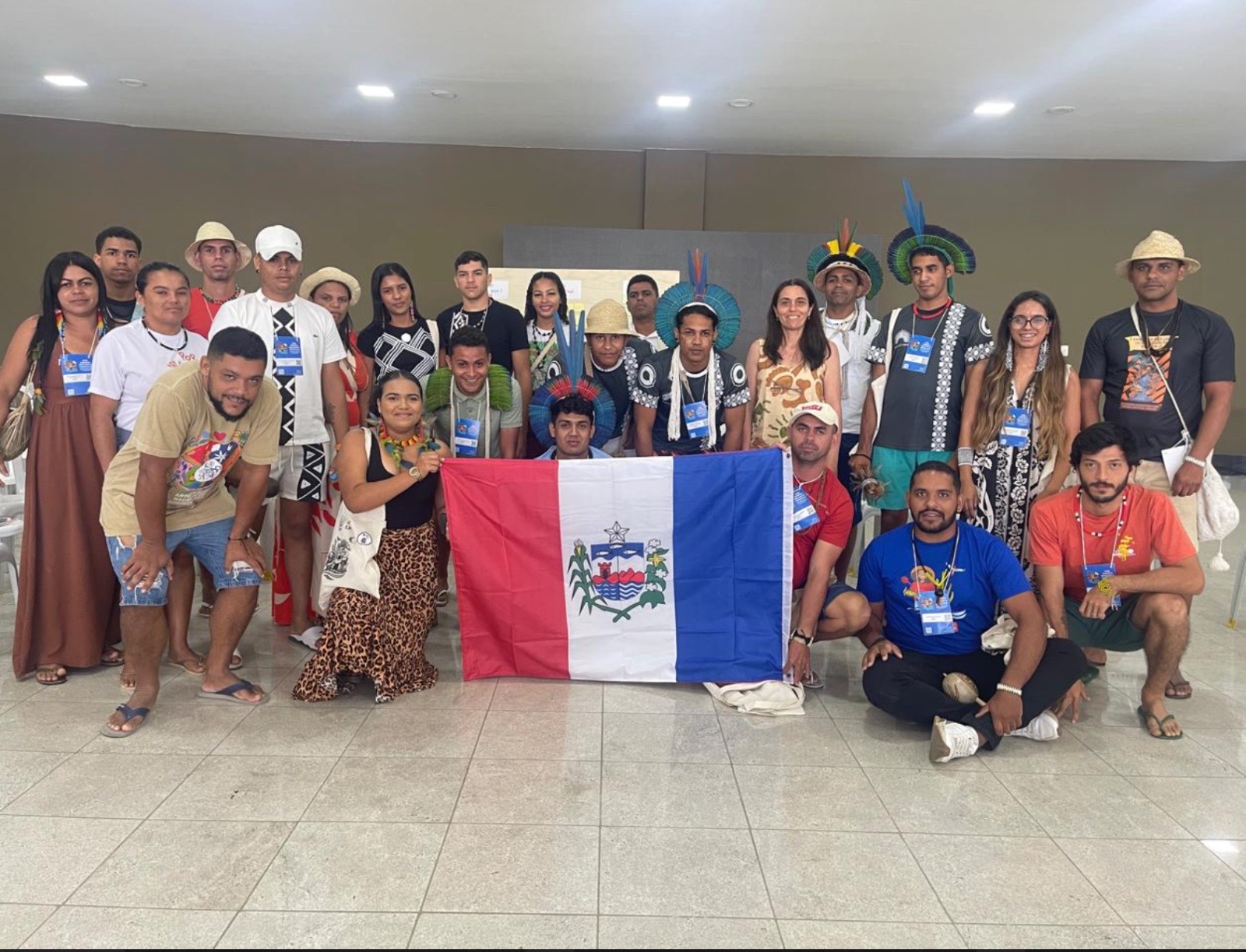
“Our ancestors always practised what we now call agroecology. Over the last two or three decades, industrial agriculture has introduced a new model, often promoted through technical assistance, which teaches farmers to buy seeds, chemicals and fertilisers, and to plant monocultures. This has disrupted the natural cycles and the health of the community we knew.” – Jairã da Silva Santos Sampaio.
More than a territory of resistance, the Tingui Botó territory is a living laboratory of ecological and cultural regeneration. The young people of the community have formed an association and have been conducting innovative experiments in Agroecology and Agroforestry Systems (AFSs), where they revive the ancestral practices of their forebears.

To learn more about this agroforestry work, its ancestral knowledge and worldview, we spoke with Jairã da Silva Santos Sampaio, an agronomist and member of the Association of Young Indigenous Producers of Tingui Botó (AYIP-TB). As one of four indigenous-led organizations in Brazil who are leading the current Blossom program, AYIP-TB are amongst an emerging movement that centers biocentric restoration as a regenerative approach to climate mitigation, land regeneration and cultural revitalization.


Indigenous knowledge systems guiding natural regeneration
Jairã points out that “Nature is what really transforms the landscape. The question is how we care for nature. Depending on how we do so, nature will respond in one way or another.” Traditional Ecological Knowledge guides this care, manifesting itself in the ability to read the land, understand the ecological needs and benefits of plants, and planting methods.
The Tingui Botó use Agroforestry Systems (AFS) to preserve two plants of great importance in their traditional culture: croà and licurí.. From an indigenous perspective, an AFS is much more than just planting trees alongside crops. It is a living, relational practice that intertwines food, medicine, water, soil health, animals and people in a web of reciprocity that sustains both the community and the ecosystem for future generations.


The AFSs that Tingui Botó’s project has implemented during Blossom, is the result of collective storytelling and work. Jairã recounted the moment when an elder shared knowledge of natural indicators for water that had otherwise gone undetected. “An elder from our village identified a plant in the area. She said that if that plant was living there, it was because there was water underground. Even before the scientific diagnosis and excavation, we already knew there would be a spring there. After excavating, we saw that there were not one but two springs.”

Securing further water recovery was reinforced with strategic planting of banana seedlings, because this tree draws a lot of water from the soil and is not concerned about getting flooded. Sweet potatoes and other crops now coexist with species such as cowpeas and crotalaria – a collaboration of nutritionally dense foods and natural soil covers that fix nitrogen, retain moisture, and enrich the soil.
The benefits are not only food on the table, but also a more fertile, diverse and resilient territory.


“We use the land and territory with respect for living and non-living beings. Human intervention on our part has been minimal — it is nature that really brings about the transformation.” — Jairã da Silva Santos Sampaio
Challenges and threats
The Tingui Botó living laboratory is not without risks. The spread of genetically modified maize monoculture in the region threatens to contaminate native seed varieties and erode biodiversity. Another major threat is aerial pesticide spraying, which destroyed crops and apiaries this year, compromising total honey production, which had reached half a tonne in 2023-2024. Even so, the Tingui Botó people are not backing down: they denounce the impacts of industrial agriculture, pressure the authorities to regulate oppressive systems, and reaffirm that their agriculture is for the culture of life.
“Some of our neighbours have chickens and ducks. So we plant sunflowers around the nursery so that the animals can eat and do not enter to damage the seedlings. We kindly ask our neighbours, who unfortunately use genetically modified corn seeds and pesticides, to do so far away from our area, so as not to poison our soil. Our idea is to influence, to show that it is possible to nourish human beings and the soil without pesticides and devastation, with respect for nature.”
Paths to biocentric restoration: Rebuilding the way of life
The Tingui Botó invest in a model that combines tradition and innovative approaches, demonstrating that indigenous approaches to restoring their territories are genuine regenerative pathways to food security, biodiversity protection, and building a just future for all.
1. Decolonising by example
“The elders have always practiced what we now call agroecology in their backyards. Over the last 20 years, with the emergence of agribusiness, another model has been promoted: monoculture, genetically modified seeds, chemical inputs: a plastic-based ‘agriculture’. This has influenced our farmers, who now buy seeds, pesticides and fertilisers and practicse monoculture.”

The community is now working to revive ancestral methods and integrate modern approaches, demonstrating that productivity does not require the purchase of agribusiness packages. For indigenous peoples, agriculture is not about profit, but about the sustainability of food, culture, and life.
2. Restoring pollinators
“Through our partnership with Embrapa Alimentos e Territórios in the city of Maceió, our community was able to transition from extractive honey collection to an organised apiary with 40 to 50 hives, achieving robust production. Our local honey brand is now showcased at fairs and conferences.”


Despite the experience with pesticides, AYIP-TB predicts that production will likely resume in the coming years as bees return to the territory. These essential pollinators contribute to the health of 90% of plant species.
3. Indigenous regeneration networks
Jairã is at the forefront of indigenous-led Agroecology. He works to highlight Indigenous Peoples and all the ancestral ecological knowledge of the movement. He organises Indigenous participation in the Brazilian Agroecology Congress, which this October will be held in the emblematic city of Juazeiro, Bahia.
Through Blossom, Tingui Botó has connected with other Indigenous communities, including the Kariri Xocó, Marajó and Xucurús. These communities will come together at the congress to bring their ancestral perspectives and learn from each other.
Young and older farmers from the program and far beyond will demonstrate how their initiatives are interconnected, sharing results that prove that Agroecology works. Together, they advocate for public policies that support Agroecological practices — essential for addressing the climatic and social challenges affecting the peoples of the waters and forests and, ultimately, all life on Earth.


A message to the world from Tingui Botó
“Agriculture is inseparable from culture, as the word itself reveals. It is not just about producing food. It also produces life, knowledge, water, relationships.”
Our project seeks to recover and redefine our ancestral knowledge, adding to it modernity. For us, the goal of agriculture is not profit. We are concerned with growing food to feed ourselves and all beings in our territory. What do we feed ourselves with? How diverse is our diet? How does production relate to our food culture?
The message we want to share with the world is that agroecology, rooted in the knowledge of traditional peoples, has the power and potential to make other worlds possible. Worlds where nature regenerates life at all levels, aided by light human interventions, rooted in a deep ecological knowledge.” – Jairã da Silva Santos Sampaio on behalf of the Association of Young Indigenous Producers Tingui Botó.