Remembering the Spirit of the White Forest
The Caatinga is a unique semi-arid biome in northeastern Brazil, home to thousands of endemic species. It covers about 11% of the national territory—an area roughly the size of France and Portugal combined.
The love for this complex ecosystem comes alive when we speak to our Indigenous partners who live here. Their lives are deeply connected to every part of the territory—from each rock, to the sacred umbu tree, to the birds exist only in memory. They understand Mother Earth as a living being that calls for care, affection and respect. They invite us to tread lightly, observe and interact with subtlety.
Meet the newest Blossom cohort
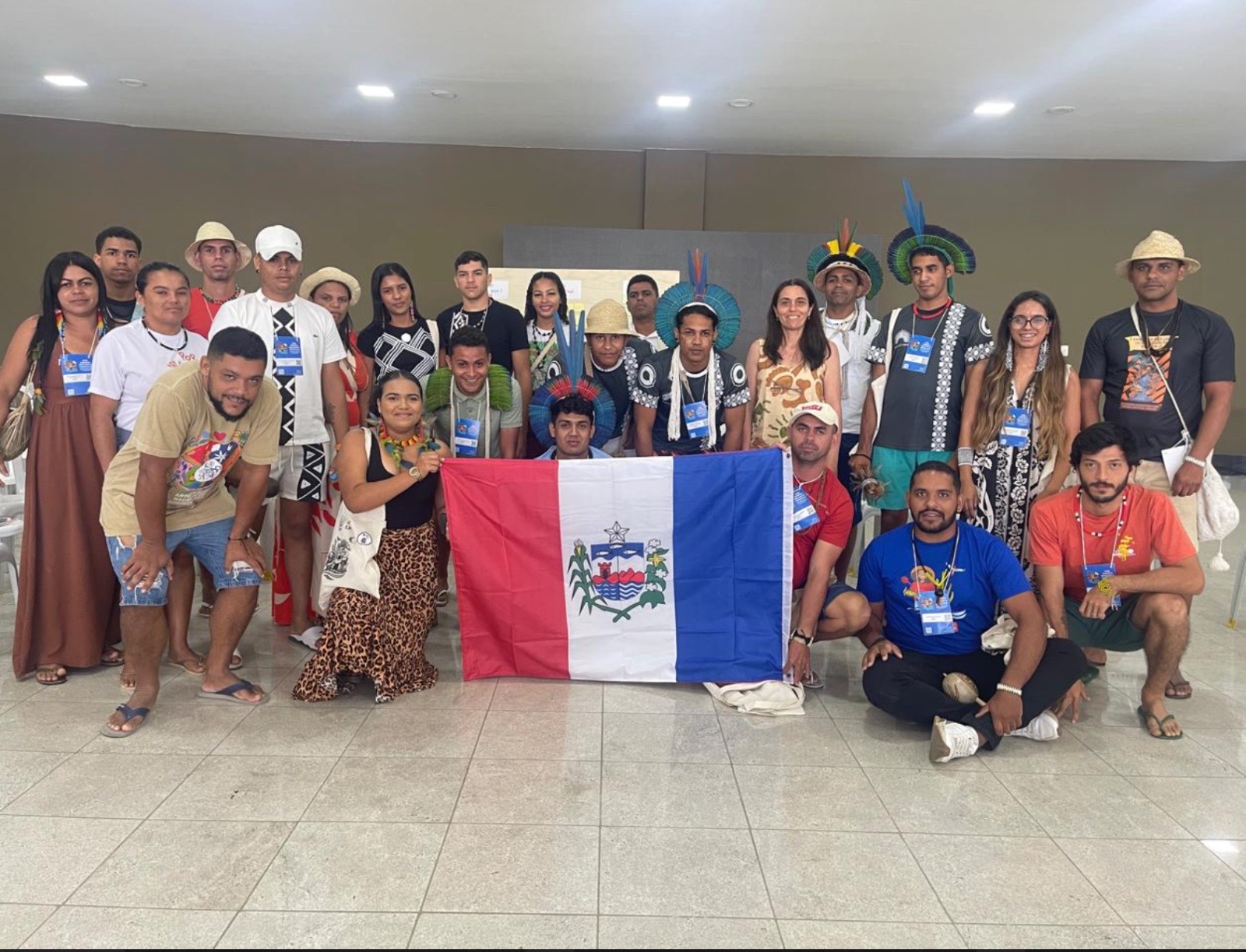
It is in this land that the newest Blossom cohort is taking root. We are partnering with and learning from four Indigenous-led organizations. As guardians of place, they are challenging the ongoing impacts of colonialism, industrial agriculture and livestock, and extractive industries. By centering Traditional Ecological Knowledge and regenerative approaches with care and commitment, they are working to restore vitality and abundance within their territories.
Coletivo Jupago Kreká

“It is necessary to promote “rewilding” for the return of wise and efficient beings in the art of planting, managing and maintaining forests, such as birds”. – Iran Xukuru, Coletivo Jupago Kreká
The Indigenous Collective Jupago Kreká is located and carries out its activities in the Xukuru do Ororubá Indigenous Territory, in the city of Pesqueira, in the Agreste region of the state of Pernambuco, within the Caatinga biome.
They promote Sacred AgriCulture, understood as a way of life in which experiences are based on living with the land without compromising its biological and spiritual life. In Xukuru cosmology, the land is seen as Mother Earth, a living macro-organism and the home of the Enchanted Kingdoms of Ororubá.
Throughout its history, the Collective has preserved 360 hectares, 100 of which have been actively regenerated by planting over 60,000 seedlings, restoring 14 springs, and engaging in ethno-mapping, ethno-zoning, and rewilding—mainly with birds and native bees. Alongside these efforts, women produce medicines and food for the community and solidarity economy networks, drawing on ancestral knowledge tied to biodiversity, which is shared through their “Escola Viva” (Living School).
In the coming years, they aim to protect and regenerate the entire 360 hectares and expand their work with other communities in their territory. By sharing knowledge and enchantments, they seek to strengthen this regeneration hub, rekindling the Encantamento across their Sacred Territory.
Associação Indígena do Marajó

The Marajó Indigenous Village is located in the municipality of João Câmara, in the Mato Grande region of the semi-arid state of Rio Grande do Norte, within the Caatinga biome.
In the words of Kaline Portiguara, leader of the Association: “We are not on the lands where we originally lived, but on lands our ancestors once used for farming. With the expansion of large farms, we lost these lands to ranchers. Thirty-four years ago, during the rise of the Landless Workers’ Movement (MST), our people left the Amarelão mother village in search of land to work, and we have been here ever since”.
Marajó is the oldest settlement in the state of Rio Grande do Norte. The association was formed in 2018 and it’s primarily run by women. Their goals are to recover their ancient Amarelão/Tupi language, medicinal plants, and traditions, regenerate their land and the hydrological cycles, and provide livelihood opportunities based on indigenous traditional agriculture.
In their own words, their objectives include:
- Promoting the socio-economic development of our community through participatory and educational projects that empower people.
- Representing our community in advocating for our rights with public and private institutions.
- Strengthening local autonomy and ethnodevelopment.
- Preserving family farming, our beliefs, rituals, and traditions.
Associação Centro de Cultura Sabuká Kariri Xocó

“Protecting the right to land is protecting the right to life”.
Associação Centro de Cultura Sabuká Kariri Xocó
The Kariri-Xocó Indigenous Village is located in the Lower São Francisco region, within the Caatinga biome and the semi-arid lands along the banks of the São Francisco River. Our community represents the union of the Kariri and Xocó nations, coming together to reclaim and strengthen our shared traditions and ancestral connections.
Since 2019, our mission has been to preserve and revitalize Kariri-Xocó traditions, ensuring that our people remain on our ancestral lands while fostering cultural resilience. Through our Cultural Center, we create spaces for knowledge-sharing, spiritual practices, and collective empowerment.
One of our greatest challenges is income generation and climate justice, as we work toward sustainable solutions that align with our Indigenous ways of life.
Our struggle for land, environmental preservation, and cultural survival is central to our existence. As we navigate these challenges, we hold onto the wisdom of our community: “The system strives to separate us, but our path is unity. That is why our Culture Center exists—to create space for this practice of gathering and connection.”
With strength and resilience, we continue our journey, honoring the land, our ancestors, and the future generations of the Kariri-Xocó people.
Associação de Jovens Produtores Indígenas Tingui Botó

“Agroecology is the principle we must follow to avoid climate collapse.”
Maquisuel Soares da Silva, Indigenous farmer and beekeeper
The Tingui Botó Indigenous Territory is located in Feira Grande, Alagoas, within the Caatinga biome, near the Boacica River, part of the São Francisco River basin, and approximately 130 km from the Atlantic Ocean. The Tingui Boto live in an environmental reserve surrounded by agrochemical farms that pollute their territory.
Founded in 2018, our organization was created to empower Indigenous youth of the Tingui Botó people through political education, environmental restoration, citizenship access, and agroecology. We believe that agroecology is essential to prevent climate collapse, guiding our efforts to restore and protect our lands.
Our main priorities include environmental restoration, reforestation with Syagrus coronata (licuri palm), and land acquisition to expand and sustain our community.
As Indigenous farmers and beekeepers, we see our work as deeply connected to the land and our ancestral knowledge. With determination and respect for our traditions, we continue to build a future rooted in sustainability, sovereignty, and the protection of our territory.
Blossom Journey Ahead
The work of these four Indigenous organizations represents more than ecological restoration—it embodies a profound reconnection between people and place that has been referred to as biocultural restoration. Their approaches remind us that the most profound solutions emerge when we honor the intimate knowledge that comes from belonging deeply to an ecosystem.
We invite you to follow the journey of these remarkable organizations as they work towards restoration, not as separate from nature, but as integral to its flourishing.