
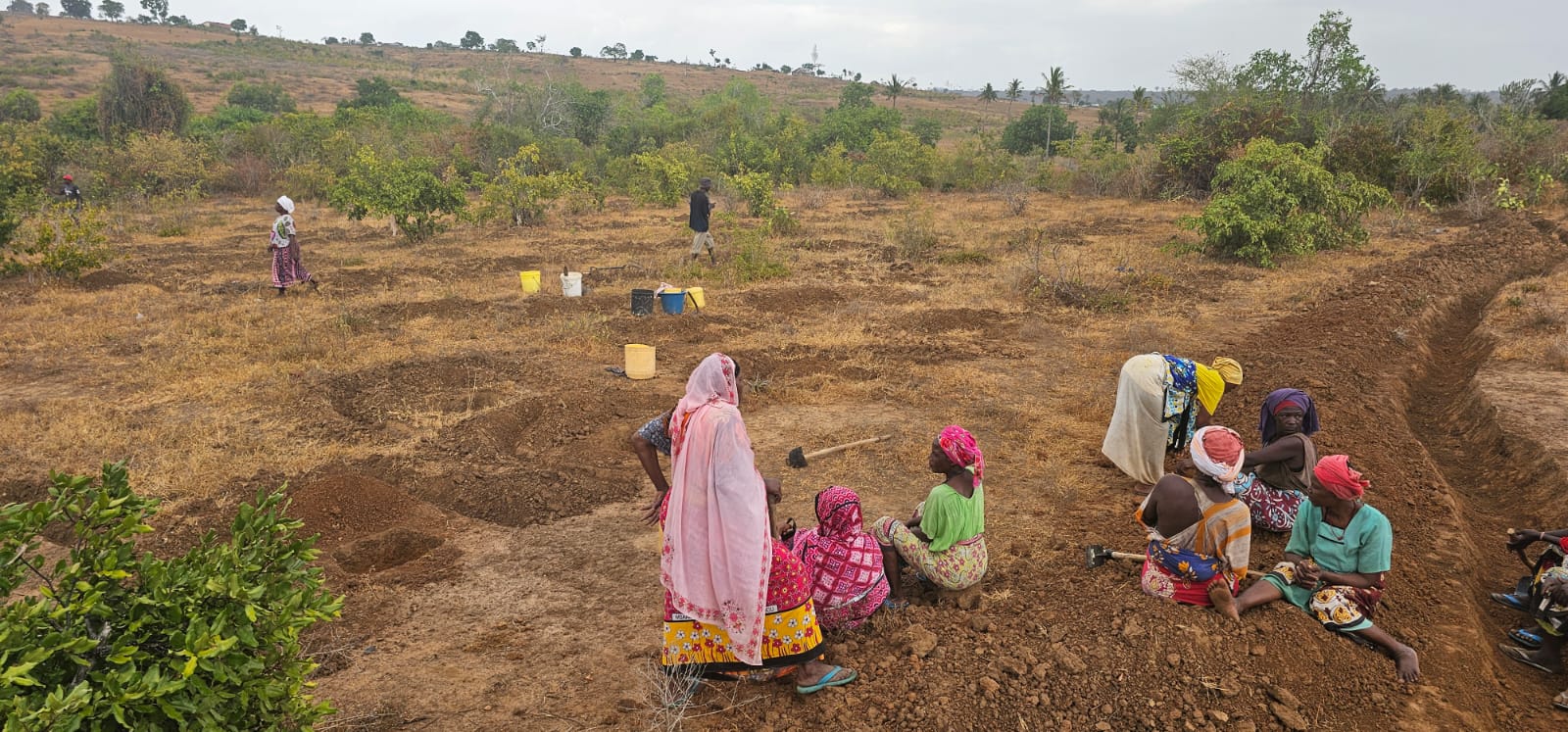
Mwanaidi Ibrahim Ruwa from Kwale County on Kenya’s coast is working with her community to restore native tree species in the sacred Kaya Forests and surrounding degraded lands. Mwanaidi is leading grassroots regeneration by advancing reforestation, water retention, and soil regeneration efforts in Kinango.
This article, written by Thiong’o Gachie, highlights how traditional knowledge and regenerative partnerships are helping protect these sacred forests.
A Journey into Culture and Resilience
The road is bumpy and dusty as we exit Mombasa Road, heading towards Kinango in Kwale County, coastal Kenya. The landscape slowly shifts from lush mixed gardens—where coconuts, neem, senna, pine, eucalyptus, bananas, cassava, cashew nuts, and mangoes thrive—to increasingly barren land. Brown grasses, parched and compacted earth, and scattered shrubs, including the invasive Prosopis juliflora (mathenge), dominate the scenery. The temperature soars to 37 degrees Celsius. Years of deforestation for charcoal, monocropping, and land clearing have left this region struggling under the weight of ecological degradation.

As we arrive, we are greeted with vibrant song and dance at the homestead of Mzee Chiti, the chairman of Kaya Duruma. Dressed in traditional Duruma shukas in black, blue, and red, he moves with energy, shaking his whisk in the air as women ululate and dance, their shoulders swaying rhythmically. Three men beat traditional drums, their feet gripping them firmly. The sight is mesmerizing—a people thriving in a harsh environment, their spirits unbroken, their traditions intact.
We are drawn into the dancing circle, warmly embraced by the community. This is the culture of the Duruma, one of the nine Mijikenda communities. Their traditions have bound them together for generations, guiding them in communal decision-making through gatherings known as dhome. In their most recent dhome, they resolved to restore a nearby kaya, one of the sacred forest sites of the Mijikenda. These kayas are more than historical settlements; they are spiritual shrines, biodiversity hotspots, and UNESCO-listed heritage sites. Yet, they are under constant threat from deforestation, land encroachment, and climate change.


For years, Grassroots Economics has worked in this region, fostering resource coordination protocols—shared agreements and sustainable practices that promote equitable resource use. At the heart of these systems are Mweria and Dhome. Mweria is a rotational labor system where community members take turns tending to each other’s homes and farms, pooling resources to support one another. With environmental degradation worsening, these ancient practices are now being integrated into ecosystem restoration. This is how Aude Perone, Jane Wegesa Fraser, and I found ourselves in Kinango, Kwale.
After the celebratory welcome, we gathered for a communal discussion. The elders officially welcomed us, and we felt honored to spend the next four days among them. They spoke of their struggles—chief among them, drought. Everyone who stood to speak echoed the same concerns: water scarcity, food insecurity, and soil degradation. Water, their most pressing need, was scarce and difficult to access. Women and children walked two to three kilometers down steep hills to fetch murky water from a communal water pan. Drinking water had to be purchased at Ksh 30 per jerrican, an expense many could not afford after two years of failed harvests. Livestock, mostly goats, drank from the same contaminated sources. Children queued for hours after school, balancing 10 and 20 liter jerry cans on their heads as they trekked back uphill.
Food scarcity was equally dire. Without vegetables, many relied on dried fish, a luxury for most, or beans, which required hours of boiling over firewood. The community maintained a tree nursery, but sustaining it was a struggle—out of over a hundred saplings planted, only a handful had survived.
The proposed solutions were practical but challenging. Many suggested purchasing water tanks to harvest rainwater, but with drought persisting for two years, storage capacity was limited. Drilling a well seemed viable, yet no boreholes existed in the area, and groundwater availability was uncertain. Eventually, we settled on excavating a communal water pan, though we all knew that harvesting and storing water in the soil and landscape would provide a more lasting solution. With this in mind, we decided to train them on building earthworks, including a pond and a swale system.
Following the meeting, we descended into the kaya. The surrounding landscape was starkly barren, with deep erosion gullies—some over ten feet deep—scarring the valley. Though the kaya remained relatively forested, the land around it was in rapid decline. Since kayas are sacred, a cleansing ritual was performed to seek ancestral blessings before we entered. Traditional songs and dances followed, and Mzee Chiti led us through the kaya, explaining the significance of each sacred site and structure.
We then visited a degraded section where months ago, hundreds of trees had been planted—but only a handful remained, casualties of drought and overgrazing. We began digging 30 planting holes, each 2 feet wide and 2 feet deep. The eroded soil had long lost its top layer, leaving behind a compacted, rocky subsoil. Around each hole, we built half-moon catchments to direct rainfall into the tree roots, minimizing runoff and erosion.


To further restore the landscape, we constructed an A-frame, a simple but effective tool for mapping contour lines. Using this, we marked where swales would be dug to capture runoff from the main road, redirecting it into the land rather than allowing it to cause erosion. We excavated a small pond at the highest point to slow and store runoff, ensuring water would seep into the ground and feed the swales. In the coming rains, these earthworks would be planted with vetiver grass to stabilize the soil. Fast-growing, nitrogen-fixing trees like leucaena, sesbania, and senna would serve as windbreaks and biomass accumulators. The community would continue this work, learning as they restore their land.
On the second day, we focused on the kitchen garden. We prepared a double-dug bed near the homestead, designed not only to grow vegetables but also to capture and retain water. We enriched the soil with manure from cows and goats, added charcoal dust for slow nutrient release, and buried branches to create a sponge-like effect underground. The bed was then heavily mulched to protect against the relentless heat, awaiting the rains for planting.
It was deeply inspiring to witness and participate in this journey—co-designing and envisioning resilient landscapes with the Mijikenda. Their traditional systems of Mweria and Dhome offer a living model of how communities can unite to address shared challenges. By coming together, pooling resources, exchanging skills, and building trust, they are not only preserving their cultural heritage but also forging a path toward ecological and social resilience.
STORY BY:

The AWYRF supports women’s leadership across regenerative approaches and entrepreneurship, aiming to address multiple interconnected challenges. These challenges include food security, climate resilience and economic empowerment. Each project is led by and for local communities, creating context specific pathways towards ecological restoration and community resilience.
The second cycle of the AWYRF Fund was resourced by the Regenerosity’s Seed Flow Funds ecosystem.

