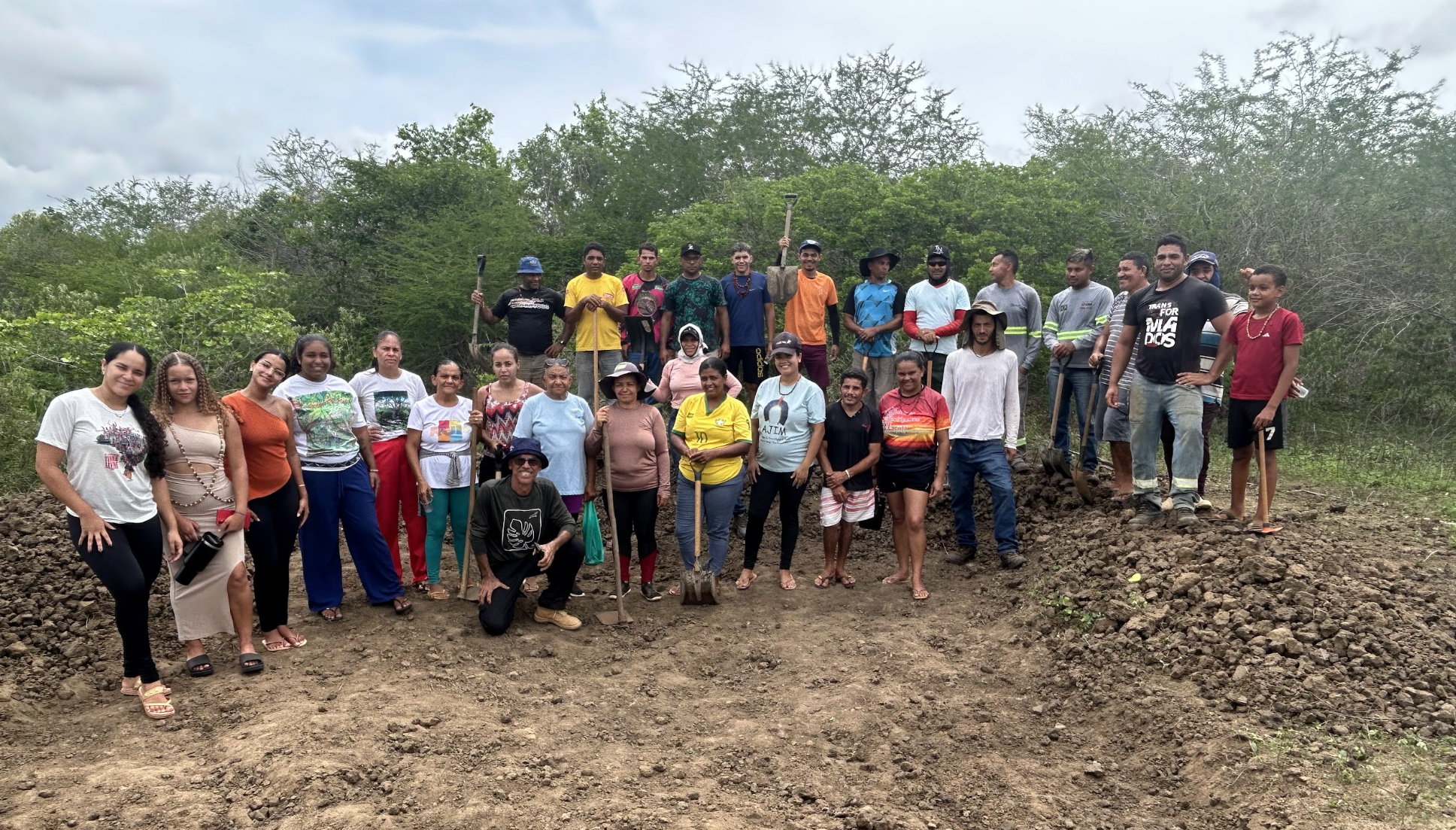
All four organizations came together from across the unique Caatinga biome, a landscape of resilient cacti and endemic species. Today, water scarcity shapes every decision, every planting season, every plan for the future. This wasn’t the group’s first meeting; having connected just months earlier at the Brazilian Agroecology Congress. But this time they gathered for a water mutirão (a Brazilian Portuguese word, derived from Indigenous Tupi language, meaning “collective work”) a fundamental connector linking the vitality of all life.
The four organizations – Coletivo Jupago Kreká, Associação Indígena do Marajó, Associação Centro de Cultura Sabuká Kariri Xocó, and Associação de Jovens Produtores Indígenas Tingui Botó – are leading the Regenerosity Blossom cohort in Brazil for 2024-2026, a two-year capacity strengthening program centered on biocentric regeneration.

About the Mendonça Indigenous Territory
The Marajó settlement is part of the broader Mendonça Indigenous Territory in João Câmara. The territory is home to Potiguara and Tapuia Indigenous families connected through the Mendonça lineage, distributed across several communities including Amarelão — the largest and most historically recognized — as well as Marajó, Açucena, Serrote, and others.
According to oral histories later documented in anthropological research, many of the Indigenous families who formed these communities migrated from older colonial settlements and mission areas in Rio Grande do Norte and Paraíba during the 18th and 19th centuries. Seeking refuge from colonial violence, forced labor, drought, and territorial displacement, they settled in relatively isolated areas of the semi-arid hinterlands, where they were able to maintain collective forms of life, kinship, and cultural continuity for generations.
Marajó is also a long-established agrarian reform settlement located within this Indigenous territory, reflecting a broader regional history of land dispossession, resistance, and reoccupation after the expansion of large ranches and agricultural estates across the region during the 20th century. Historical accounts from the Mendonça communities describe how Indigenous families progressively lost access to their lands as farms expanded and territories were enclosed. Today, thousands of people live across these communities, maintaining strong cultural, family, and territorial ties in the Caatinga biome. The name “Amarelão” (“Big Yellow”) is associated with ancestral sun rituals remembered by the community, while “Mendonça” refers to a shared ancestral lineage and collective Indigenous identity shaped through generations of resistance, migration, and territorial reorganization in Brazil’s semi-arid Northeast.


Today, each of the original families of the settlement is a guardian of 25 hectares of land, totalling more than 1800 hectares, much of that protected as native Caatinga vegetation. Cashew nut processing provides the main source of income. Most of the cashews processed locally, however, come through intermediaries rather than from local production — a challenging dynamic that often results in very low pay for community members. Local cashew production itself remains limited and highly dependent on rainfall. Subsistence agriculture supplements livelihoods, while handicrafts using gourds, vines, and both native and non-native seeds – crafted into necklaces, bracelets, earrings, dreamcatchers, maracas, and other items – both contribute economically and preserve and celebrate their culture.


The Marajó territory sits within a semi-arid watershed shaped by recurring droughts, and experiencing the compound pressures of climate change, industrial agriculture and historical land dispossession. Water access in the region is deeply affected by local hydrogeological conditions: much of the groundwater is naturally saline or brackish due to the mineral composition of the soils and underground rock formations, including limestone.
Prior to the water workshop, Regenerosity supported the community’s efforts to establish a drilled well, as part of broader landscape regeneration strategies for water security, groundwater recharge and the restoration of traditional water sources.
The water mutirão focused on two key activities: the cleaning-up of a small seasonal stream, and the implementation of simple rainwater harvesting and retention strategies across the landscape.
Community members collectively cleared and restored the stream bed — dry for many years — in order to make the first steps in an attempt to restore the river basin, in the hopes that one day it can once again function as a channel for rainwater infiltration. The restoration also carried a strong symbolic dimension, reconnecting the community with a watercourse where many older residents remember swimming as children.
Alongside this effort, participants learned and implemented practical water retention techniques adapted to the semi-arid landscape, including swales, infiltration ditches, and a simple social technology known as the rain catcher: a low-cost system using a tarp, piping, and a small water tank to collect and store rainwater for irrigating surrounding plants.


Mapping Water Across the Territory
The workshop was facilitated by Newton Campos, a grassroots educator from the Plantagua Association (located in the state of Espírito Santo, Southeast Brazil). The activities began at the headquarters of the Marajó Association, where participants gathered for introductions and an initial conversation about water, territory, and the challenges faced in the semi-arid region. During this opening moment, Newton Campos shared stories and lessons from the experience of Sítio Jaqueira and the work of Plantágua, both dedicated to restoring water cycles and regenerating degraded landscapes. He also introduced participants to key principles of the water cycle, groundwater recharge, and rainwater retention in the landscape, connecting these ideas to the local reality of Marajó.
From there, the group set out on a collective walk through the territory for a process of landscape reading — observing slopes, soils, vegetation, water flows, erosion patterns, and existing areas of cultivation and pasture. More than a technical assessment, the walk became a shared process of listening to the territory and exchanging memories and observations about how water once moved through the landscape, how these dynamics have changed over time, and what to do to regenerate the land.

Agroecological Interventions for Water Security
What followed was the implementation of multiple water-focused interventions, each chosen based on where the community’s priorities and energy naturally aligned, supported by technical knowledge from the facilitators.

Caça-Chuva (Rain Catcher)
Participants collectively built a caça-chuva (“rain catcher”), a simple rainwater harvesting system using a tarp, piping, and a small water tank to capture and store rainwater for irrigating nearby plants. Designed as a low-cost and easily replicable social technology, the system offers a practical way to strengthen water security and support small-scale food production in the semi-arid landscape.

Swales in the Caatinga’s intense but irregular rainfall patterns are essential infrastructure for making the most of every drop, transforming brief rains into long-term soil moisture that sustains crops and trees through drought periods. Rather than allowing water to run off the surface – carrying soil and nutrients with it – swales capture rainfall and direct it into the ground, recharging aquifers and reducing erosion.

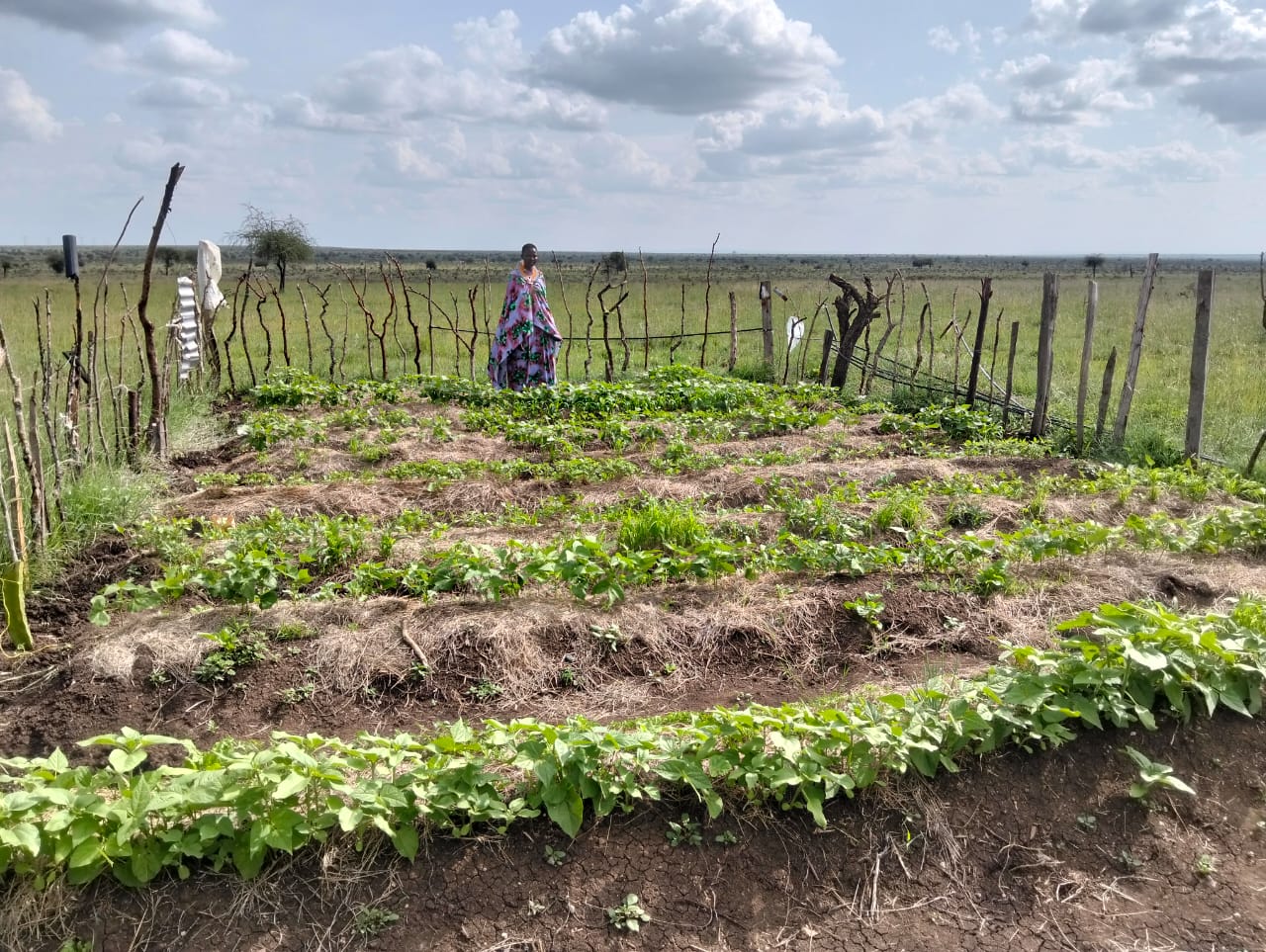
Mulching involved covering soil with organic materials such as dry leaves and branches, mainly coming from the cleaning of the creek bed. This practice reduces evaporation, moderates soil temperature, suppresses weeds, and gradually builds soil fertility as the mulch decomposes. In semi-arid regions, mulch can reduce water needs by up to 50% while protecting vulnerable topsoil from wind and water erosion. For communities dependent on rain-fed agriculture, mulching transforms limited biomass into a water conservation strategy.
The group also began implementing a multi-species dryland agroforestry system adapted to the semi-arid landscape, interplanting species as cashew and pitaya (dragon fruit), banana, aloe vera, and green manure plants. This diversification provides multiple income sources while creating a layered canopy that reduces evaporation and builds ecosystem resilience. Nopale cactus was planted specifically to cut, harvest, and use or bury during times of drought, providing both emergency fodder and a means of retaining moisture in the soil during the most critical periods.


During the workshop, participants also visited the community planting area developed as part of the broader project supported by Regenerosity. These visits created space for exchanges of knowledge and experience around the ongoing management of the area, generating practical insights and collective reflections on soil regeneration, water retention, planting strategies, and the long-term resilience of the system.
Throughout the workshop, each learning exchange was energised by a shared commitment to the restoration of traditional water sources. The activities were also enriched by the presence of agroforestry technician Lucas Ital, who shared valuable knowledge, practical guidance, and technical insights to support the implementation of the agroforestry system.


What’s next
The immediate outcomes are tangible: swales that will capture the next rains, agroecology systems where plants reciprocate each other in different ways and stages in the soil, and portable set ups that harvest rainwater.
But the long term outcomes are relational and systemic through the health of the river and surrounding ecosystem and the livelihoods of families, the preservation of cultural practices and the wellbeing of future generations. The restoration of traditional water sources is in service of the health of all relationships.
Associação Indígena do Marajó and nearby communities continue to advance water access activism and multirão organizing. Further technical support for water retention landscapes and regenerative agriculture is planned alongside sustained work to improve cashew nut production and processing. As well as resources allocated to enable the Mendonça communities to attend Acampamento Terra Livre (Brazil’s largest Indigenous mobilization and advocacy gathering, taking place in Brasilia). Further interviews with well drillers are planned to deepen understanding of groundwater potential as well as ongoing watershed restoration assessments.
This critical work continues.
The Blossom program supports Indigenous-led organizations in long-term biocentric restoration through trust-based partnerships. Learn more about the journey of these four organizations at regenerosity.world/blossom.